
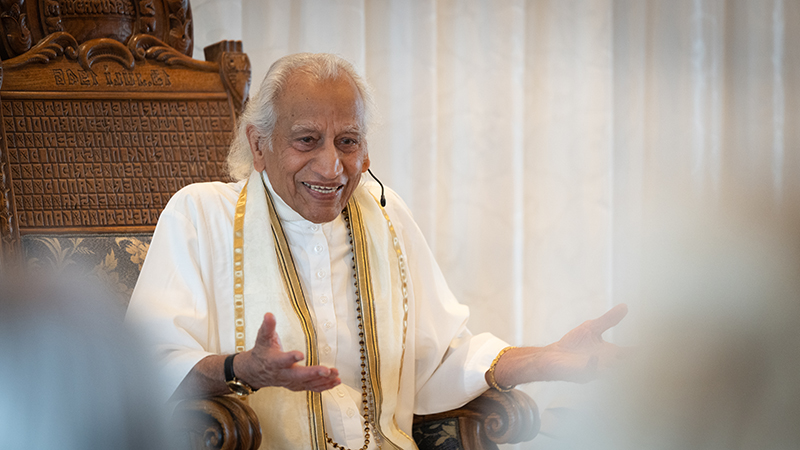
By Gurudev Shri Amritji
The personality is the reactive perceiver, a self-image that builds its own personal reality through the medium of the mind as it moves through time. It divides experience into good and evil, friend and enemy, my side and your side, then lives inside the drama those divisions create. These divisions do not arise from life itself, they arise in the reactive perceiver and are superimposed onto love life, family life, work life, and social life. The script of this inner drama is stored in the unconscious, where reactively processed energy quietly directs perception beyond the reach of the conscious mind. This reactive perceiver is a self-generated entity with no real existence, one that has separated itself from the true Self and then lives in the world it has imagined.
The reactive perceiver builds a personal world through the mind, like a video game being generated from inside you as you move through time. In this inner game, characters are assigned roles as friends and enemies, good and bad, my side and your side. The reactive self-image becomes the director of this game, casting outer life into these roles and then responding to the drama it has created. The script for these good-and-evil storylines is stored in the unconscious, where reactively processed energy programs perception beyond conscious access. This inner script is continuously projected onto life, shaping not only experience, but the psychosomatic structure of the self-image itself.
Stress develops when the body’s innate self-regulating intelligence is overloaded, and more tension is produced than the nervous system can naturally release. These unresolved tensions eventually register in the tissues and nervous system, interfering with the biological rhythm of inhalation and exhalation. When the breath loses its natural balance, the entire autonomic network is affected, including respiration, circulation, digestion, and elimination. Breath in and breath out form a single biological polarity, marking the body’s continuous exchange between activation and release, intake and letting go. When unconscious habits and reactions constrain this polarity, life force becomes bound in the autonomic system, and this bound life force is what is the root cause of stress.
Unhappiness is irritating because you are naturally driven toward your true nature, your natural state of bliss, just as a headache is irritating because the body wants to return to a natural state of health and freedom. You do not want to get rid of your head, because your head is part of you. In the same way, you cannot get rid of your desire for happiness, but you can learn how to approach it so that it does not create unhappiness. When the desiring mind finds the object, person, or situation it is seeking, the tensions and restlessness of the anxious mind temporarily subside. What is called pleasure or happiness is not held in the person or object, it is in the satisfaction the mind experiences when the frantic search ends, and the quietness that naturally follows is felt as fulfillment. This means that happiness is not coming from what is found, it is revealed when seeking stops.
No matter how much positive thinking you do, thoughts cannot remove the negative feelings that are built into the energy body. To create a shift in the body, you must feel your feelings and experience your experiencing, which in yoga is called tapas, the purification of the feeling center, the emotional clearing ground for the conditioned past. This means learning to tolerate and be patient with what you are feeling again and again, without thinking reactively in order to pacify it. When you feel at ease, relaxed, and peaceful in your feeling center, the energetic block has been cleared. As soon as the energetic block is cleared, the body begins returning to its natural self-balancing, self-healing, restorative, and regenerative functions, because this kind of healing cannot happen at the level of the mind, it can only happen at the level of the feeling body.
Many people practice yoga and meditation with an end in mind, approaching the journey as a goal to be reached only after a long passage through body-mind conflict. When practice is driven by a future result, the mind lives in time, the body is pulled out of the present, and each step is experienced as struggle, with the body used as a means to an end. The ecstasy of Oneness does not arise through a future goal, it arises in the timeless Here and Now and is felt directly through the same body and mind. When you live Here and Now, life is guided by spontaneous biological response rather than by the pursuit of more pleasure. Living in the present moment is living in body-mind harmony, where each step becomes a lived practice and a harmonious co-creation with your own body.
When the feeling body and the thinking mind are totally present, they together become a bridge through which Spirit manifests. This is the central focus of I AM Yoga®, anchoring the mind in bodily sensation. When attention is scattered or emotions are disturbed, yoga postures become a battleground between body and mind rather than a doorway into union. Yoga practice must intentionally aim toward body-mind union, where Hatha Yoga prepares the foundation Raja Yoga through pratyahara, dharana, and dhyana to naturally unfold. As you move into a posture so completely that there is no actor outside the action, the achiever and performer dissolve, and the walls of ego fall away. This is authentic yoga that sets the stage for spiritual awakening, when ego is absent and union is present.
Since material existence cannot always be blissful, the most effective way to reduce pain is to develop higher consciousness rather than trying to control outer conditions. Resistance to reality, including the reality of suffering, always increases pain, while animals suffer less because they do not mentally resist aging, illness, or death. Human suffering is amplified by thinking about pain and trying to impose will upon it, while pain diminishes when reality is embraced and life is met beyond likes, dislikes, and the need to forgive. The tranquility and inner freedom of yoga emerge when identity shifts from matter to Spirit, which begins by asking, “Who am I, who is aware of my body and my thoughts, and why am I choosing to focus on fear, desire, and repulsion?” Since energy follows attention, practice swadhyaya, nonjudgmental self-observation through witness consciousness, allowing awareness to illuminate experience and surrendering the rest to God.
Unresolved conflict remains dormant in the unconscious and resurfaces again and again, reactivated by association until it is resolved. Through thinking, we identify with opposing experiences, creating exclusion, and exclusion gives rise to conflict with a compulsive force. Total, undivided attention has no exclusion and no division. It embraces the present unconditionally and carries the integrative power of choiceless awareness. When we give power to people and situations by holding them responsible for our unhappiness, we lose contact with our own inner power. Experiences free of the self-image become an adventure of moment-by-moment Self-discovery.
The search for truth takes different paths, not only for different people, but also for the same person at different stages of the inner journey. For some, the search for truth moves outward, for others it turns inward, and for many it unfolds as a living movement between both. Whenever truth is realized, even intellectually, it brings you closer to your divine potential for experiencing, recognizing, and realizing love, peace, and harmony in life. Truth is more powerful than any self-projected illusion you may have lived with, because it dissolves doubt and fear, and strengthens and supports your inner clarity. Understanding truth is the beginning of personal transformation, because truth becomes the foundation of life and the ground through which right understanding expresses itself in action and relationships.
The background of reactive thoughts is the unconscious past, and it seeks love from others and outside while moving away from the source of love. Behind all physical and mental movement there is stillness, and energy, matter, and mind all arise and move within that still background. Creative thought arises from a non-reactive, responsive mind, while reactive thought arises from personal history and unconscious conditioning. The mind itself is objective and impersonal, responding to what is present, while reactive thoughts are personal creations, and the mind is the container while thoughts are its contents. After enlightenment, the mind is still present, yet it is empty of reactive thoughts. What appears in the present is the consequence of past karma and is reality, while reaction to the present is mistaken reality.
When you face an experience that is too painful for the self-image to bear, fear arises, and the instinct is to run from it or fight it, as if the self-image were facing a real threat to survival. Every choice for or against experience operates inside the safety of self-concepts, protecting and reinforcing who you think you are. This mistaken identity, taking the self-image to be yourself, consumes life-force energy, because every physical, mental, and emotional act becomes organized to sustain it. Before information is accepted, the ego reshapes it through interpretation and rationalization to fit its needs, while what does not fit is ignored and denied entry into normal, retrievable memory. What is ignored, denied, and suppressed does not disappear, it is registered in the unconscious as samskaras, incomplete gestalts that remain stored, awaiting completion. These samskaras continue to surface through emotion, behavior, and life situations, until what was avoided is consciously met and resolved.
The spiritual journey begins with recognizing the problem: time-bound memories continuously distort present perception, creating personal conflict with impersonal reality. Much of what is experienced as struggle does not come from what is happening now, it comes from the past being projected onto the present through personality and conditioned perception. The process that releases these preprogrammed patterns is called swadhyaya, or self-study, learning to observe everything that enters awareness without identifying with it. As this meditative awareness deepens, it becomes a lived orientation of attention, where perception is no longer guided by habit and memory, but by what is actually present. The practice of I AM Yoga Nidra teaches you how to disengage from distorted perceptions created through the filters of personality and to rest in non-reactive presence. From here, you step out of the closed circle of safety and familiarity and begin to form a relationship with unfamiliarity without fear, doubt, or emotional reaction.
The Higher Power is hidden within. When you enter nonmental stillness, you enter the innermost core of peace that is beyond understanding. When you go beyond the ego-mind, you enter this hidden dimension, the I AM within you. As you enter this innermost state of being, mental and emotional states of doing subside, and the waves of turmoil, stress, and conflict begin to quiet. Moving deeper into this stillness, you touch a boundless inner state, where you know yourself beyond personality and beyond history. The moment identification with the mind-made self loosens, you enter a timeless dimension of stillness, and the body is experienced as a temple and the heart as an altar. In this sacred inner chamber, you receive the grace of knowing that you are divine.
In trying to solve external problems, the ego mind lives in perpetual conflict and stress, and this stress, created by mental and emotional agitation, drives people toward self-destructive patterns and substances in search of relief. These strategies only treat the effect. The cause, the chronically stress-producing personality hidden in the unconscious, remains untouched. Problems that appear to be outside are mirrors of problems that have not yet been resolved within. Yogis discovered that real change happens by entering another dimension, the invisible inner realm where deep, integrative, and sustainable transformation begins from within. When attention turns inward to the level where stress is generated, the unconscious patterns that drive conflict can finally be met rather than acted out. At the level of choiceless awareness, the cause of stress is encountered at its source, so the personality can begin releasing its patterns from within rather than continuing to seek relief outside.