
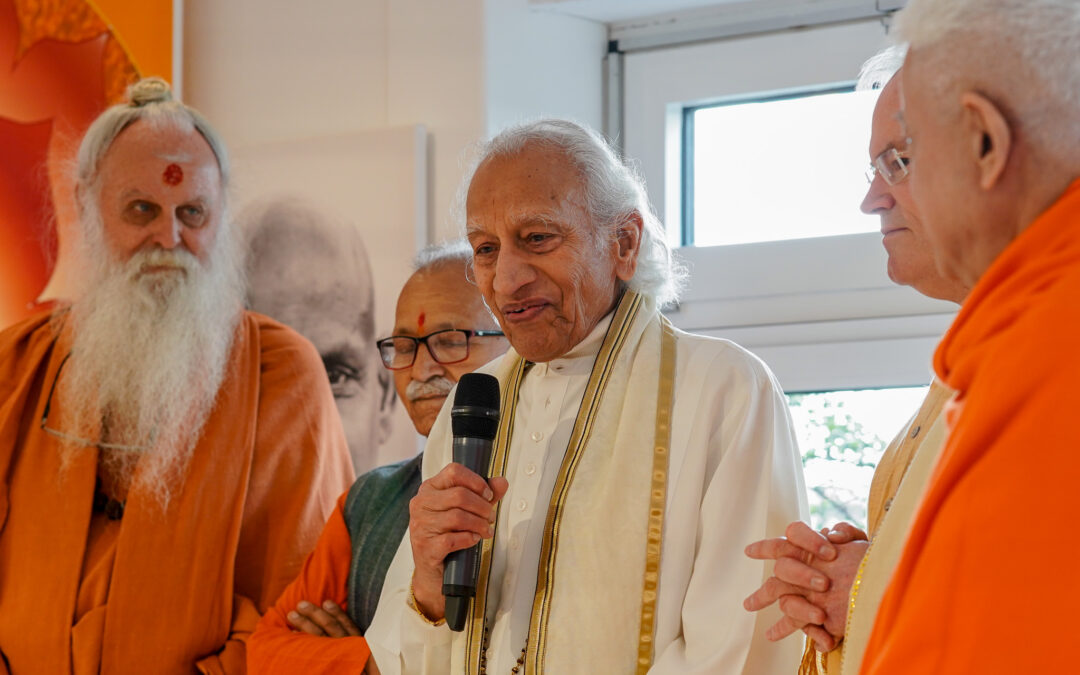
Written by Gurudev Shri Amritji
Popularly, modern yoga focuses on hatha yoga. You may have practiced asanas for many years, stretching, strengthening, and purifying the body, and after your practice, you feel your nervous system balance and the breath settle into ease. These benefits are real, yet in most settings, yoga practice concludes with savasana guided relaxation rather than a direct recognition of the eternal presence within.
Most people think of asana (postures) and pranayama (breath control) when they hear the word “yoga”. These components are a portion of hatha yoga, which also includes yama (restraints) and niyama (observances).
When separated from the meditative depths of raja yoga, including pratyahara (withdrawal of the senses), dharana (concentration), and dhyana (meditation), it is incomplete.
Hatha and Raja are One
It is said, “Without hatha yoga there is no raja yoga, and without raja yoga there is no hatha yoga.”
My guru, Swami Kripalu, whom we call Bapuji, wrote a commentary on the Hatha Yoga Pradipika, the classic text of hatha yoga.
Although the typical translation of the Sanskrit word hatha is force, he explains that ha means the sun and tha the moon, and the union of the sun and the moon is hatha yoga.
Raja yoga is translated as “royal yoga.”
“Sun-moon yoga is the seed state, the child state and the antecedent state of royal yoga; and royal yoga is the potent state, the adult state and the subsequent state of sun-moon yoga.”
The author of the Hatha Yoga Pradipika, Svatmarama, says in the second verse that the practice of hatha yoga is “only for the attainment of royal yoga.” Near the end of the text, he says, “I consider the labor of those aspirants who do not know royal yoga and who only do the sun-moon continued practice, to be without fruit.”
Bapuji also explains that when hatha yoga is practiced through stubborn insistence, it produces a stillness he calls “hatha (forced) equanimity.” Of those who practice this way, he says, “Their inertness appears as the equanimity of royal yoga, but they are not the same.”
Meditation in Motion®: A Bridge to Raja Yoga
Patanjali says, “Yoga means witnessing the modifications of the mind.” This should be the central practice regardless of what limb of Patanjali’s Ashtanga Yoga you are focusing on at any given time.
I call the practice of I AM Yoga® “Meditation in Motion®.” It is the combination of hatha and raja yoga, and the unifying element is witnessing.
When you practice yoga as witnessing the modifications of the mind, you are disengaging from the false self-image that is the carrier of reactive processing of thoughts and emotions, and your practice becomes a Self-discovery process.
When practiced in this way, postures themselves may spontaneously arise from the life energy, prana, and not from the mind. These spontaneous movements are known as prana kriyas, which Bapuji calls “natural purifying actions,” explaining that “those purifying actions not governed by the mental faculty are purifying actions of the life energy.”
He gives a simple example: when you are asked to sit down, you do not think about which posture to sit in. “You give autonomy to your feet. They naturally arrange themselves in a comfortable posture; this is purifying action of the life energy, or natural action.” Animals, who know nothing of yoga, move this way all the time: “The postures which they take are not taken by means of the mental faculty, but by means of the life energy.” This is why he says, “The mental faculty is the means of bondage and the life energy is the means of liberation.”
The same is true of the breath, for in raja yoga, pranayama is not only a preparation but a direct entry into awareness itself. The Hatha Yoga Pradipika says, “When the life energy located in the body is restless, the mental faculty is also restless, and when the life energy is stable, the mental faculty is also stable.”
Bapuji explains that in spontaneous yoga, the breath comes to rest by itself: “this is the real hold, because it is naturally stable.” The presence is not created by pranayama; it is uncovered through it.
In practice, Meditation in Motion® asks this of you:
- In each posture, witness the thoughts and emotional reactions that arise, without following them.
- Instead of counting cycles or seeking a physiological effect, rest in the pure witnessing of the inflow and outflow of breath.
- After your postures, sit in stillness and bring full awareness to what is present.
Why go deeper?
Your body is the visible soul, for the soul is formless, divine potential that manifests through the body.
Every time you reactively and emotionally process an experience, it is registered in your energy body. What is created at the level of the mind is re-created at the level of the body. During the waking hours, the ego mind creates more stress than the body can restore during sleep, so the unresolved tension is built into the body as energy blocks and into the mind as emotional blocks. The Bhagavad Gita says that your mind can be your worst enemy or your best friend.
When you witness your reactions, you are disengaging from the karmic memories of the past. It can be compared to a bright light covered by layers of lampshades that prevent the light from shining fully. As you remove each layer of karmic impressions, the light of consciousness, which has never been affected by the layers, shines brighter.
The Hatha Yoga Pradipika describes how this shows up in the body, listing among the signs of accomplishment in sun-moon yoga “a serene expression on the face … purity of the eyes, absence of disease” (verse 2.78), and noting that as the subtle energy channels are purified, “the lightness and lustre of the body are obvious” (verses 2.19–2.20).
What to expect?
Most people who embark upon a spiritual journey hope to escape the ups and downs of their love life, family life, work life and social life, without knowing that what they avoided, suppressed and denied in the past will resurface in the journey back to the source. The ups and downs of the inner journey are created by the catharsis of the past.
When you witness the emotional reactions that create the ups and downs, you are disengaging from your karmic memories of the past, and it brings you closer to the oneness, the source of presence that I AM. You still go through ups and downs, but you are not struggling to go up and striving to stay up, neither are you afraid when you are down. Your witnessing presence acts as a doorway through which you can go beyond them.
The Posture of Consciousness®
Consciousness has two wings: one wing is human potential, which science has used to reveal the secrets of the body and the cosmos, and the other wing is Being potential. Humanity has been fluttering one wing and trying to become airborne, and more and more people are becoming aware that it is impossible.
More and more people are attracted to explore the Being potential that represents the other wing of consciousness. I AM Yoga® teaches how to develop the Posture of Consciousness®, as a meditative practice of hatha yoga leading to the luminous presence that I AM within.